STD Testing in Morrisonville, NY: Free, Same-Day & Confidential
Syphilis in Clinton County is reported about 84% less often than the US average. If you're in Morrisonville, New York for one-time or regular check-ups, consider that you can visit a clinic to ask questions and start treatment, or use an at-home test kit to collect your own sample when convenient.
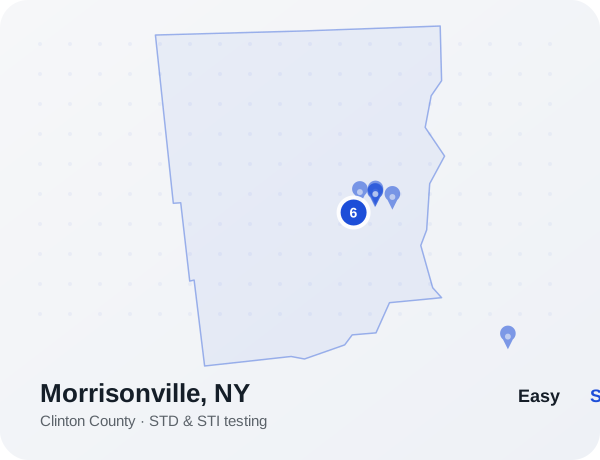
6 testing options are listed for Morrisonville, NY. The nearest, Labcorp, is about 1.2 miles away. Compare community and public clinics, private labs, and at-home kits below.
How to read these listings
Listings tagged Community health center are federally funded health centers and rural clinics that treat everyone regardless of insurance or ability to pay: required to bill on a sliding fee scale and provide confidential care, and in many states minors may consent to their own STI testing. A Title X tag flags centers funded for confidential family-planning services; confirm current participation when you call.
Source: CMS FQHC & Rural Health Clinic enrollment files (data.cms.gov), refreshed quarterly. Title X status reflects the latest OPA grantee list.
Location unavailable — enter a ZIP code or city instead.
Premium Partner
Labcorp
Most popular Results in 1–2 days
2.8(7)?Where these reviews come from
Review sources
Google6
EasySTD1
Rated 2.8 out of 5 from 7 reviews
Address
16 Degrandpre Way, Plattsburgh, NY 12901 1.2 miles away
Today's offer: $10 off any test panel, applied automatically at checkout.
Community health center 2.6 miles
Plattsburgh Pediatric and Adolescent Health
3.3(5)?Where these reviews come from
Review sources
Google4
EasySTD1
Rated 3.3 out of 5 from 5 reviews
A community safety-net federally qualified health center about 3 miles from Morrisonville. Sliding-scale STD testing and care are typical here, call ahead to confirm the exact panel and pricing.
Hudson Headwaters Health Network in Plattsburgh requires an appointment, so scheduling ahead is the move, but that single visit covers rapid HIV and hepatitis C testing, the full bacterial panel, same-visit treatment for gonorrhea, chlamydia, and syphilis, plus vaccines, with all services provided at no fee.
Read full overviewShow less
Every Service Runs at Zero Cost
Hudson Headwaters absorbs the cost of every service it offers (testing, treatment, vaccines, PrEP) which means the scope of what you do in one appointment isn't shaped by what you can afford to add on.
On-Staff Interpretation, Not a Callback
Hudson Headwaters maintains interpretation services for non-English languages as part of clinic operations, meaning a qualified interpreter is part of the care encounter itself, present for the clinical conversation rather than patched in after the fact.
PrEP Prescribed and Managed On-Site in Plattsburgh
Hudson Headwaters holds PrEP as a standing clinical service (prescribed, monitored, and refilled here) which serves anyone without a regular provider or whose insurer makes the medication expensive elsewhere, since all services run at no fee regardless.
English, Interpretation Services Available for Non-English Languages
Tests offered
Hepatitis C Rapid
TB
Gonorrhea
Syphilis
Chlamydia
Rapid HIV
Serves
Black or African American persons
Hispanic or Latino persons
LGBTQ
Low Income Persons
Men Who Have Sex with Men (MSM)
Care services
Family Planning
STI Treatment
Human Papillomavirus Vaccine (HPV)
Hepatitis A Vaccine
Adult Hepatitis B Vaccine
Prevention services
TB Prevention/Education
STI Prevention/Education
HIV/AIDS Prevention/Education
Hepatitis Prevention/Education
Condom Distribution
Fees & payment
Donations Accepted
Medicaid Accepted
Medicare Accepted
Fee
Insurance Accepted
Free HIV Test
Free Hepatitis C Test
Listing verified Feb 2026 · Source: CDC NPIN
Community health center 4.6 miles
Planned Parenthood of the North Country New York
3.5(22)?Where these reviews come from
Review sources
Google20
EasySTD2
Rated 3.5 out of 5 from 22 reviews
Planned Parenthood of the North Country New York in Plattsburgh tests for gonorrhea, chlamydia, syphilis, herpes, and HIV, treating bacterial infections the same visit; fees run on a sliding scale accepted by Medicaid and most insurance, with appointments required.
Read full overviewShow less
Staffed for Non-English Conversations, Not Workarounds
Interpretation services at this Plattsburgh clinic are integrated into care delivery itself, not patched in after the fact. That means the clinical conversation, including symptom history and treatment instructions, moves through a live interpreter rather than being compressed into whatever English a patient can manage under pressure.
Title X Covers Minors With Legal Confidentiality
As a Title X–funded clinic, Planned Parenthood of the North Country New York provides legally confidential family planning and STI services to minors. Meaning a parent's insurance is not billed and a guardian's consent is not required. That federal protection is built into the funding structure, not left to staff discretion.
PrEP, PEP, and DoxyPEP Prescribed Here Directly
Chasing prevention medications across multiple providers means gaps: in time, in coverage, and sometimes in whether a prescription gets filled at all. Planned Parenthood of the North Country New York in Plattsburgh prescribes PrEP, PEP, and DoxyPEP on-site, so ongoing HIV and bacterial STI prevention doesn't depend on a separate specialist agreeing to take the case.
Beyond the dedicated testing centers above: at-home kits by mail, hospital labs certified for STI testing, local clinicians who can order a panel during a regular visit, pharmacies for self-test kits and prescriptions, and online PrEP & treatment.
The nearest testing center is about 1 mile away; if you'd rather skip the trip, an at-home kit ships to Morrisonville, you collect the sample privately, and mail it back to a CLIA-certified lab. Results come online in days, with a clinician available if anything is positive. Same labs as a clinic, no waiting room, and you can read how accurate at-home STD tests are before you order.
Want a free option first? The CDC-supported TakeMeHome (opens in a new tab) program mails free at-home HIV self-test kits, and, in many areas, free STI kits, to your door, with no insurance or payment needed. The paid kits below add broader panels and faster turnaround.
In-home collection
$79 & up
Panel:
8-infection panel incl. chlamydia, gonorrhea, HIV, syphilis, hepatitis & herpes: single tests too
Sample:
Quest Mobile: a phlebotomist collects your sample at home
Every kit uses CLIA-certified labs. At-home testing is for screening; a reactive result should be confirmed and treated by a clinician. Prices and panels shown are illustrative and change often, confirm current details on the provider's site.
Also in the area
Other CLIA-certified labs near Morrisonville, NY
Beyond the public testing sites above, these federally certified (CLIA) labs serve Clinton County, each lab's town is shown on its card below. Many test through a doctor's order or by appointment rather than walk-in, so call ahead to confirm STD/STI testing and availability before visiting.
Source: CMS CLIA registry (Provider of Services), Q1 2026. Federal public records: active CLIA-certified laboratories near Morrisonville. A CLIA certificate records only that a laboratory is federally certified — it does not confirm the site performs STD testing, nor its hours, price or access. Inclusion is not an endorsement; always call to verify.
Local clinicians
Clinicians near Morrisonville, NY who may help arrange STD testing
Beyond dedicated clinics, 335 primary-care, OB-GYN, infectious-disease and other clinicians have a CMS practice record within 30 miles of Morrisonville. They may be able to evaluate symptoms or order a confidential STD panel during a regular visit, and 124 offer telehealth.
These are registry-listed clinicians, not dedicated STD-testing clinics. CMS records do not independently verify current licensure, testing services, availability, price, or new-patient status. Confirm each detail before booking. Source: CMS Doctors & Clinicians.
Nearby pharmacies
Pharmacies near Morrisonville, NY
No pharmacy near Morrisonville, NY publishes an STD-related service or holds a current CLIA testing certificate, so these are simply the closest. Contact a location directly to confirm counter hours, services, prices, and availability before visiting.
Showing the 5 closest pharmacies to Morrisonville, NY.
Directory records identify nearby pharmacies. Service, stock, price, and hours information is shown only when supported by current location-specific evidence.
Prevention & treatment
PrEP, prevention & online treatment
Testing is one step. For residents of Morrisonville, telehealth covers the rest: HIV-prevention medication (PrEP) and DoxyPEP to lower future risk, and discreet online treatment if a result comes back positive. All prescribed by licensed U.S. clinicians.
Online treatment
Visit from $0 insured
Telehealth STI treatment and sexual-health care, delivered or to your pharmacy
Pricing varies by insurance and changes often, confirm on the provider's site. These services are not a substitute for emergency care.
STD stats & rates
STDs & HIV in Clinton County: the local picture
How reported STI rates in Clinton County, the county that includes Morrisonville, compare with New York and U.S. averages, based on the most recent 2023 surveillance data. An estimated ~19% of residents are aged 15–34 (ACS), the age group with the highest reported chlamydia and gonorrhea rates nationally.
#38
#38 of 62 New York counties for chlamydia, a higher rate than 39% of the state
Reported STD rates per 100,000, Clinton County vs New York vs U.S.
Clinton CountyNew YorkU.S.▲▼ = Clinton County vs the state average
Infection
Clinton County
New York
United States
Chlamydia
217.6170 cases▼ 61%
558.4
492.2
Gonorrhea
3225 cases▼ 86%
235.6
179.5
Syphilis (P&S)
2.62 cases▼ 82%
14.8
15.8
Syphilis (early)
2.62 cases▼ 89%
23.1
16
Syphilis (late/unknown)
6.45 cases▼ 75%
25.2
29.5
Rates per 100,000 population, 2023. Source: CDC NCHHSTP AtlasPlus (county, state & U.S., all-ages basis). Population figures: U.S. Census Bureau ACS. These figures are the latest available surveillance estimates. Bars are scaled to the highest rate shown.
Reading these numbers: reported case rates only count infections that were actually tested for and diagnosed, so they track local screening effort as much as true spread: a higher rate can reflect more testing, a lower one less. Either way, most STIs cause no symptoms, so treat the figures above as context rather than a verdict, and test on the CDC's schedule regardless of how your area looks.
Reported STD rates in Clinton County over time (per 100,000)
Chlamydia ▲ 0% vs 2022
Chlamydia Gonorrhea Syphilis (P&S)
Between 2020 and 2023 in Clinton County, chlamydia has fallen from 254.2 to 217.6 per 100,000 (14%), gonorrhea has risen from 21.3 to 32 per 100,000 (50%), and P&S syphilis has risen from 2.5 to 2.6 per 100,000 (4%).
The 2020 dip reflects reduced pandemic-era screening, not lower transmission. Source: CDC NCHHSTP AtlasPlus (county, state & U.S., all-ages basis).
Community health context
What shapes testing access in and around Morrisonville, NY
Adults uninsured
5.1%
No routine checkup
19.1%
No transportation
6.3%
Binge drinking
16.4%
Frequent mental distress
16.4%
Depression
22.2%
Below poverty line
10.3%
Primary-care ratio
1,244 : 1
Clinton County
Primary-care shortage score 17 / 26
Social Vulnerability Index · 44th percentile nationally
Sources: CDC PLACES (ZIP), County Health Rankings, CDC/ATSDR SVI, HRSA HPSA, HRSA MUA/P, Neighborhood Atlas ADI. Lower insurance coverage, fewer routine checkups, and a thin primary-care ratio all raise the value of low-cost public clinics and at-home testing in Clinton County.
Local HIV snapshot
HIV in Clinton County (2023)
People living with HIV
385 / 100k
New diagnoses (2023)
5cases countywide
PrEP users / 100k
107 · PnR 14.6
Clinton County HIV care continuum (2023)
Clinton County recorded 7.3 new HIV diagnoses per 100,000 (2023), against 14.1 statewide and 13.7 nationally. Among Clinton County residents living with HIV, 71.5% are in care · 65.8% are virally suppressed. Early, routine testing is what moves these numbers: it is the entry point to PrEP, treatment, and viral suppression.
Sources: AIDSVu (Emory/Gilead) · CDC AHEAD · CDC AtlasPlus · CDC NCHHSTP AtlasPlus (county care continuum). The CDC recommends everyone aged 13–64 test for HIV at least once: every lab and clinic listed above offers HIV testing, and free rapid HIV testing is available at a local health department.
Pregnant or planning to be?
Congenital syphilis is the fastest-rising STI: what to test, and when
Congenital syphilis, passed from parent to baby in pregnancy, is the fastest-rising STI in the country. U.S. cases climbed from 2,163 in 2020 to 3,882 in 2023. It is almost entirely preventable: the CDC recommends a syphilis test at the first prenatal visit, and every clinic and lab listed for Clinton County tests for syphilis.
Source: CDC NCHHSTP AtlasPlus, 2023 (county-level congenital syphilis is not published).
Compiled and checked by EasySTD's editorial team against CDC and public-health sources. This is educational information, not a substitute for advice from a licensed clinician. Our editorial guidelines → (opens in a new tab)
LaPierre Lane Riverway Park anchors a community where most adults own their homes, most are married, and households run close to three people. A profile where health decisions rarely happen in isolation. When one partner schedules a screening, the conversation often touches the whole household, which can make things easier or, depending on the relationship, more fraught to bring up. That household density also reflects a working town.
Nearly three-quarters of residents are in the labor force, unemployment is low, and a meaningful share of families earn comfortably, yet the cost of holding onto a home here still shapes how people spend their hours and their attention. For younger adults, the people in their late teens and twenties who represent the years when STIs circulate most actively, getting tested means deliberately carving out time: Morrisonville runs along NY 190 and feeds onto I-87, and the options listed on this page require a real drive, not a walk or a quick errand detour. With so few renters and so many dual-income households, the barrier isn't usually cost. It's the calendar.
Clinton County's STI figures reflect patterns common to rural upstate communities, where geography slows down the care people intend to seek. Staying current on screening means not letting months turn into years between tests, which, for a place this settled and this busy, is the real ask.
Getting there
How residents reach STD testing in Morrisonville, NY
Walkability4.74 / 20 · Least walkable
At 4.74/20 on the EPA walkability index, day-to-day errands in Morrisonville generally mean driving: plan on a car or rideshare to reach a clinic, and check each listing's hours and phone before you go.
Source: EPA National Walkability Index 2021.
ZIP 12962 snapshot
Residents
5,131
Median age
45.7
Median income
$67,511
ZIP-level Census figures for the wider 12962 area around Morrisonville: a single ZIP can span several communities, so they describe the area, not Morrisonville alone.
Morrisonville sits in Clinton County, ZIP 12962. Local context that shapes where residents test:
Local landmarks
LaPierre Lane Riverway Park
East Morrisonville Park
Twinstate
May Currier Park
Cadyville Recreation Park
Peter S. Bulmette Park
Major routes
NY 190 (Military Turnpike)
I 87 (Adirondack Northway)
Nearby cities & towns
Nearby cities and towns near Morrisonville, NY
Just outside Morrisonville? These nearby communities have their own testing guides: clinics, at-home kits, and free screening close to home.
STD testing in Morrisonville, NY: screening, costs & privacy
Everything to know before you test in Clinton County: the CDC's screening guidelines, each infection's detection window, per-test reference prices, and your privacy rights under New York law. If you have symptoms right now, our confidential symptom checker maps them to the tests worth considering.
Who should test, and when
CDC screening schedule + each infection's detection window
Who should get tested, and how often
Based on current CDC screening recommendations.
Group
Tests
How often
Everyone aged 13–64
HIV
At least once
Sexually active women under 25
Chlamydia, gonorrhea
Every year
Women 25+ with new or multiple partners
Chlamydia, gonorrhea
Every year
Pregnant people
HIV, syphilis, hepatitis B & C, chlamydia
Early in pregnancy
Gay & bisexual men (MSM)
Chlamydia, gonorrhea, syphilis, HIV
Every 3–6 months
Anyone who shares injection equipment
HIV, hepatitis B & C
At least yearly
All adults at least once
Hepatitis C
At least once
When to test: STD detection windows
Testing too early can return a false negative, confirm timing with a Morrisonville-area provider.
Medicare reference prices per lab test, a benchmark before you pay out of pocket
These are the federal Medicare reference prices for processing each lab test. Public clinics and the community health centers serving Morrisonville often test free or on a sliding scale; private labs and at-home kits bundle several tests into one fee. Use this as a per-test benchmark before you pay out of pocket, or see the full guide to STD test costs for insurance, free, and at-home options.
Test
Reference price
CPT / HCPCS
Chlamydia (NAAT)
$47.80
87491
Gonorrhea (NAAT)
$47.80
87591
Trichomoniasis (NAAT)
$47.76
87661
HIV-1/2 antigen/antibody
$26.87
87389
HIV-1/2 antibody
$22.44
86703
Syphilis (RPR/VDRL)
$5.61
86592
Syphilis (treponemal antibody)
$17.49
86780
Herpes (HSV NAAT)
$47.76
87529
Hepatitis B surface antigen
$15.33
87340
Hepatitis C antibody
$29.16
86803
Source: Medicare Clinical Laboratory Fee Schedule, CMS, 2025 rates (data.cms.gov). Reference rate for the lab assay only: a clinic visit, sample collection, or a bundled multi-test panel may cost more. Medicaid and most insurers cover STD screening at no out-of-pocket cost.
Confidentiality & consent in New York
Minor consent and partner treatment (EPT) under state law, plus how to test privately
Two things that actually depend on New York law: who can consent, and whether partners can be treated without their own visit. Everything else about testing privately is the same nationwide (see below).
Can a minor consent on their own?
In New York, a minor of any age can consent to confidential STI testing and treatment on their own, no parental permission is required.
Can my partner be treated too? (EPT)
New York permits Expedited Partner Therapy (EPT): if you test positive for chlamydia or gonorrhea, your provider can give you medication (or a prescription) to pass to your partner, no separate exam or appointment needed for them.
Keeping a test private works the same in every state. Whether an STD test shows on insurance (the EOB), how to test anonymously, and self-pay options that leave no insurance trail don’t change by location.