STD Testing in Seneca, OR: Same-Day, Low-Cost & Confidential

Despite running about 83% lower than the US average, chlamydia was reported in Grant County. If you're concerned about a one-time issue or need regular check-ups in Seneca, Oregon, weigh the convenience of same-day testing at some clinics against the flexibility of labs and at-home kits. Review your options below.

Find a lab
  • Clinics, labs & at-home kits compared
  • Free & low-cost options included
  • Backed by CDC, CMS & Census data
  • Editorially reviewed

STD testing near Seneca, OR

No STD testing centers are located in Seneca, OR. The nearest, Labcorp, is about 105.2 miles away. At-home STD kits and online lab tests ship to your ZIP; compare private labs and at-home kits below.

Free tool · not a clinic

When can I test? Exposure-window calculator

Testing too soon can miss an infection. Enter the date of possible exposure to see the earliest a test can reliably detect each STI.

Detection windows for every STI
Infection Earliest reliable test Conclusive after
Chlamydia 7 days after exposure 14 days after exposure
Gonorrhea 7 days after exposure 14 days after exposure
Trichomoniasis 7 days after exposure 28 days after exposure
HIV (NAT / RNA) 10 days after exposure 33 days after exposure
HIV (4th-gen Ag/Ab) 18 days after exposure 45 days after exposure
HIV (antibody) 21 days after exposure 84 days after exposure
Syphilis 21 days after exposure 42 days after exposure
Hepatitis B 21 days after exposure 42 days after exposure
Hepatitis C 56 days after exposure 77 days after exposure
Herpes (HSV) 28 days after exposure 112 days after exposure

Guidance only, confirm timing with a clinician. A negative result before the conclusive date may need a repeat test.

Find your match in 10 seconds

What matters most to you?

What will it cost? Estimate your STD test

Typical out-of-pocket ranges by option, actual cost depends on which tests you need.

  • Public / community clinic

    Free HIV testing is common

    $0–$25
  • Private lab (self-pay)

    Never billed to insurance

    $24–$200
  • At-home kit

    Mailed to your door, private

    From $49
  • Doctor / urgent care

    Often $0 preventive with insurance

    $0–$50 copay

Rate this clinic

Rate what mattered to you, no account needed. Reviews are moderated before publishing.

Privacy & discretion
Wait time
Staff & comfort
Value for cost

Every other option

More ways to get tested in Seneca, OR

Beyond the dedicated testing centers above: at-home kits by mail, hospital labs certified for STI testing, local clinicians who can order a panel during a regular visit, pharmacies for self-test kits and prescriptions, and online PrEP & treatment.

At-home STD testing in Seneca, OR

The nearest testing center is about 105 miles away; if you'd rather skip the trip, an at-home kit ships to Seneca, you collect the sample privately, and mail it back to a CLIA-certified lab. Results come online in days, with a clinician available if anything is positive. Same labs as a clinic, no waiting room, and you can read how accurate at-home STD tests are before you order.

Want a free option first? The CDC-supported TakeMeHome (opens in a new tab) program mails free at-home HIV self-test kits, and, in many areas, free STI kits, to your door, with no insurance or payment needed. The paid kits below add broader panels and faster turnaround.

Every kit uses CLIA-certified labs. At-home testing is for screening; a reactive result should be confirmed and treated by a clinician. Prices and panels shown are illustrative and change often, confirm current details on the provider's site.

Other CLIA-certified labs near Seneca, OR

Beyond the public testing sites above, these federally certified (CLIA) labs serve Grant County, each lab's town is shown on its card below. Many test through a doctor's order or by appointment rather than walk-in, so call ahead to confirm STD/STI testing and availability before visiting.

  • Blue Mountain Hospital

    170 Ford Road, John Day, OR 97845

    CMS-certified lab

    • STD testing

Source: CMS CLIA registry (Provider of Services), Q1 2026. Federal public records: active CLIA-certified laboratories near Seneca. A CLIA certificate records only that a laboratory is federally certified — it does not confirm the site performs STD testing, nor its hours, price or access. Inclusion is not an endorsement; always call to verify.

Pharmacies near Seneca, OR

No pharmacy near Seneca, OR publishes an STD-related service or holds a current CLIA testing certificate, so these are simply the closest. Contact a location directly to confirm counter hours, services, prices, and availability before visiting.

  • Albertsons/Safeway 38 mi
    Rx pickupHPV & Hep B vaccinesCondoms / EC
  • Access Prime Pharmcy

    38 mi
    Rx pickupCondoms / EC
  • Rite Aid 39 mi
    Rx pickupOTC HIV self-testPrEP/PEP fillsHPV & Hep B vaccinesCondoms / EC

Showing the 3 closest pharmacies to Seneca, OR.

Directory records identify nearby pharmacies. Service, stock, price, and hours information is shown only when supported by current location-specific evidence.

PrEP, prevention & online treatment

Testing is one step. For residents of Seneca, telehealth covers the rest: HIV-prevention medication (PrEP) and DoxyPEP to lower future risk, and discreet online treatment if a result comes back positive. All prescribed by licensed U.S. clinicians.

Pricing varies by insurance and changes often, confirm on the provider's site. These services are not a substitute for emergency care.

STDs & HIV in Grant County: the local picture

How reported STI rates in Grant County, the county that includes Seneca, compare with Oregon and U.S. averages, based on the most recent 2023 surveillance data. An estimated ~15% of residents are aged 15–34 (ACS), the age group with the highest reported chlamydia and gonorrhea rates nationally.

#35 of 36 Oregon counties for chlamydia, among the lowest in the state

Reported STD rates per 100,000, Grant County vs Oregon vs U.S.

Grant County Oregon U.S. ▲▼ = Grant County vs the state average
Infection Grant County Oregon United States
Chlamydia
83.2 6 cases ▼ 77%
362.5 492.2
Gonorrhea
13.9 1 cases ▼ 88%
117.2 179.5
Syphilis (P&S)
13.9 1 cases ▼ 28%
19.2 15.8
Syphilis (early) — no data 9.6 16
Syphilis (late/unknown) — no data 19.7 29.5

Rates per 100,000 population, 2023. Source: CDC NCHHSTP AtlasPlus (county, state & U.S., all-ages basis). Population figures: U.S. Census Bureau ACS. These figures are the latest available surveillance estimates. Bars are scaled to the highest rate shown.

Reading these numbers: reported case rates only count infections that were actually tested for and diagnosed, so they track local screening effort as much as true spread: a higher rate can reflect more testing, a lower one less. Either way, most STIs cause no symptoms, so treat the figures above as context rather than a verdict, and test on the CDC's schedule regardless of how your area looks.

Reported STD rates in Grant County over time (per 100,000)

Chlamydia ▼ 25% vs 2022
Chlamydia Gonorrhea Syphilis (P&S)
0 100 200 2020202120222023

Between 2020 and 2023 in Grant County, chlamydia has fallen from 165.9 to 83.2 per 100,000 (50%), gonorrhea has fallen from 27.7 to 13.9 per 100,000 (50%), and P&S syphilis has risen from 13.8 to 13.9 per 100,000 (1%).

The 2020 dip reflects reduced pandemic-era screening, not lower transmission. Source: CDC NCHHSTP AtlasPlus (county, state & U.S., all-ages basis).

Community health context

What shapes testing access in and around Seneca, OR

Adults uninsured
6.9%
No routine checkup
24%
Binge drinking
13.6%
Frequent mental distress
16.8%
Depression
25.8%
Below poverty line
10.1%
Primary-care ratio
1,039 : 1
Grant County
  • Primary-care shortage score 15 / 26
  • Medically Underserved Area · IMU 35.4
  • Social Vulnerability Index · 58th percentile nationally

Sources: CDC PLACES (ZIP), County Health Rankings, CDC/ATSDR SVI, HRSA HPSA, HRSA MUA/P, Neighborhood Atlas ADI. Lower insurance coverage, fewer routine checkups, and a thin primary-care ratio all raise the value of low-cost public clinics and at-home testing in Grant County.

Local HIV snapshot

HIV in Grant County (2024)

PrEP users / 100k
64

Grant County HIV care continuum (2022)

Grant County recorded 0 new HIV diagnoses per 100,000 (2022), against 6.6 statewide and 13.7 nationally. Early, routine testing is what moves these numbers: it is the entry point to PrEP, treatment, and viral suppression.

Sources: AIDSVu (Emory/Gilead) · CDC AHEAD · CDC AtlasPlus · CDC NCHHSTP AtlasPlus (county care continuum). The CDC recommends everyone aged 13–64 test for HIV at least once: every lab and clinic listed above offers HIV testing, and free rapid HIV testing is available at a local health department.

Pregnant or planning to be?

Congenital syphilis is the fastest-rising STI: what to test, and when

Congenital syphilis, passed from parent to baby in pregnancy, is the fastest-rising STI in the country. U.S. cases climbed from 2,163 in 2020 to 3,882 in 2023. It is almost entirely preventable: the CDC recommends a syphilis test at the first prenatal visit, and every clinic and lab listed for Grant County tests for syphilis.

Source: CDC NCHHSTP AtlasPlus, 2023 (county-level congenital syphilis is not published).

15 Sources

Local resources & officials

Data & references

About Seneca, OR

US 395 cuts straight through Seneca, and for most residents the nearest testing option is a real drive along that highway. A practical reality worth naming when you're thinking about routine screening. Seneca tilts heavily toward homeownership and married households, which shapes how people think about sexual health here: screening tends to feel like something for other circumstances, not a standing priority. But younger adults, people in their late teens and twenties, are building relationships in exactly the years when regular STI checks matter most, and that quiet assumption that "we're settled here" can quietly delay care that's straightforward to get.

With fewer than one in five households renting, the social texture skews toward longer-term stability, yet that doesn't make anyone immune to the infections the county data already reflects. Low typical rents keep one common barrier, cost anxiety, relatively modest for many people, and the options listed on this page include sliding-scale and low-cost formats that work within that reality. The bigger equation in Seneca is schedule: just over half the working-age population is in the labor force, and those who are often carry the inflexible hours that come with rural employment. Several of the listed options offer extended or weekend availability, so a trip down US 395 doesn't have to wait for a day off that never quite arrives.

Getting there

How residents reach STD testing in Seneca, OR

Walkability 7.28 / 20 · Below average

At 7.28/20 on the EPA walkability index, day-to-day errands in Seneca generally mean driving: plan on a car or rideshare to reach a clinic, and check each listing's hours and phone before you go.

Source: EPA National Walkability Index 2021.

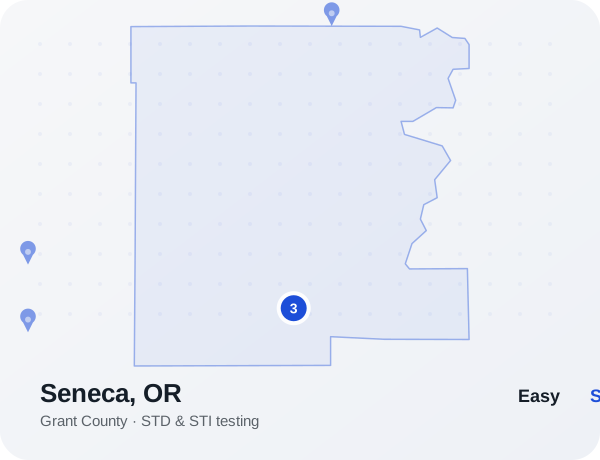
Map of 3 STD & STI testing locations in Seneca, Oregon, EasySTD

ZIP 97873 snapshot

Residents
119
Median age
58.8
Median income
$76,250

ZIP-level Census figures for the wider 97873 area around Seneca: a single ZIP can span several communities, so they describe the area, not Seneca alone.

Seneca sits in Grant County, ZIP 97873. Local context that shapes where residents test:

Major routes

  • US 395 (John Day-Burns Highway)

STD testing in Seneca, OR: screening, costs & privacy

Everything to know before you test in Grant County: the CDC's screening guidelines, each infection's detection window, per-test reference prices, and your privacy rights under Oregon law. If you have symptoms right now, our confidential symptom checker maps them to the tests worth considering.

Who should test, and when

CDC screening schedule + each infection's detection window

Who should get tested, and how often

Based on current CDC screening recommendations.

GroupTestsHow often
Everyone aged 13–64 HIV At least once
Sexually active women under 25 Chlamydia, gonorrhea Every year
Women 25+ with new or multiple partners Chlamydia, gonorrhea Every year
Pregnant people HIV, syphilis, hepatitis B & C, chlamydia Early in pregnancy
Gay & bisexual men (MSM) Chlamydia, gonorrhea, syphilis, HIV Every 3–6 months
Anyone who shares injection equipment HIV, hepatitis B & C At least yearly
All adults at least once Hepatitis C At least once

When to test: STD detection windows

Testing too early can return a false negative, confirm timing with a Seneca-area provider.

InfectionEarliest reliable testSample
Chlamydia 1–2 weeks Urine or swab
Gonorrhea 1–2 weeks Urine or swab
Trichomoniasis 1–4 weeks Urine or swab
HIV (NAT / RNA) 10–33 days Blood
HIV (4th-gen Ag/Ab) 18–45 days Blood
HIV (antibody) 3–12 weeks Blood / oral
Syphilis 3–6 weeks Blood
Hepatitis B 3–6 weeks Blood
Hepatitis C 8–11 weeks Blood
Herpes (HSV) 4–16 weeks (antibody); swab a sore Blood / swab

What each STD test costs

Medicare reference prices per lab test, a benchmark before you pay out of pocket

These are the federal Medicare reference prices for processing each lab test. Public clinics and the community health centers serving Seneca often test free or on a sliding scale; private labs and at-home kits bundle several tests into one fee. Use this as a per-test benchmark before you pay out of pocket, or see the full guide to STD test costs for insurance, free, and at-home options.

TestReference priceCPT / HCPCS
Chlamydia (NAAT) $47.80 87491
Gonorrhea (NAAT) $47.80 87591
Trichomoniasis (NAAT) $47.76 87661
HIV-1/2 antigen/antibody $26.87 87389
HIV-1/2 antibody $22.44 86703
Syphilis (RPR/VDRL) $5.61 86592
Syphilis (treponemal antibody) $17.49 86780
Herpes (HSV NAAT) $47.76 87529
Hepatitis B surface antigen $15.33 87340
Hepatitis C antibody $29.16 86803

Source: Medicare Clinical Laboratory Fee Schedule, CMS, 2025 rates (data.cms.gov). Reference rate for the lab assay only: a clinic visit, sample collection, or a bundled multi-test panel may cost more. Medicaid and most insurers cover STD screening at no out-of-pocket cost.


Confidentiality & consent in Oregon

Minor consent and partner treatment (EPT) under state law, plus how to test privately

Two things that actually depend on Oregon law: who can consent, and whether partners can be treated without their own visit. Everything else about testing privately is the same nationwide (see below).

Can a minor consent on their own?

In Oregon, a minor of any age can consent to confidential STI testing and treatment on their own, no parental permission is required.

Can my partner be treated too? (EPT)

Oregon permits Expedited Partner Therapy (EPT): if you test positive for chlamydia or gonorrhea, your provider can give you medication (or a prescription) to pass to your partner, no separate exam or appointment needed for them.

Keeping a test private works the same in every state. Whether an STD test shows on insurance (the EOB), how to test anonymously, and self-pay options that leave no insurance trail don’t change by location.

Learn more about confidential STD testing in Oregon

Source: Guttmacher Institute, Minors' Access to STI Services; CDC, Legal Status of Expedited Partner Therapy. General information, not legal advice.

STD testing FAQs for Seneca, OR

Answers to the questions people ask most before getting tested.

Where can I get tested for STDs in Seneca, OR?

The closest is Labcorp (105.2 mi).

What does STD testing cost around Seneca, OR?

Private labs ~$24–$139, at-home kits $49+.

Which tests are offered near Seneca, OR?

Local options test for Chlamydia, Gonorrhea, Syphilis, Herpes, Hepatitis A, Hepatitis B, Hepatitis C, Rapid HIV, a full panel covers the common ones.

How common is chlamydia in Grant County?

About 83 cases per 100,000 residents (2023), below the Oregon average.

Can someone under 18 get tested in Oregon without a parent?

In Oregon, people under 18 can consent to confidential STD testing and treatment on their own.

I had unprotected sex, should I get tested?

Yes, test after the window period, and if HIV exposure is a concern, ask about PEP within 72 hours.

How long until syphilis is detectable?

Roughly 3–6 weeks after exposure for a dependable syphilis blood test.

What samples are used for STD testing near Seneca, OR?

It depends: a blood draw covers HIV, syphilis, and hepatitis, while urine or a swab covers chlamydia and gonorrhea.

Can oral herpes spread to the genitals?

Yes, HSV-1 from the mouth can spread to the genital area through oral sex.

Can trich be treated?

It's cured with antibiotics; treating partners together prevents reinfection.

Have a different question? Browse the full STD & STI FAQ library, every question we answer, in one place.